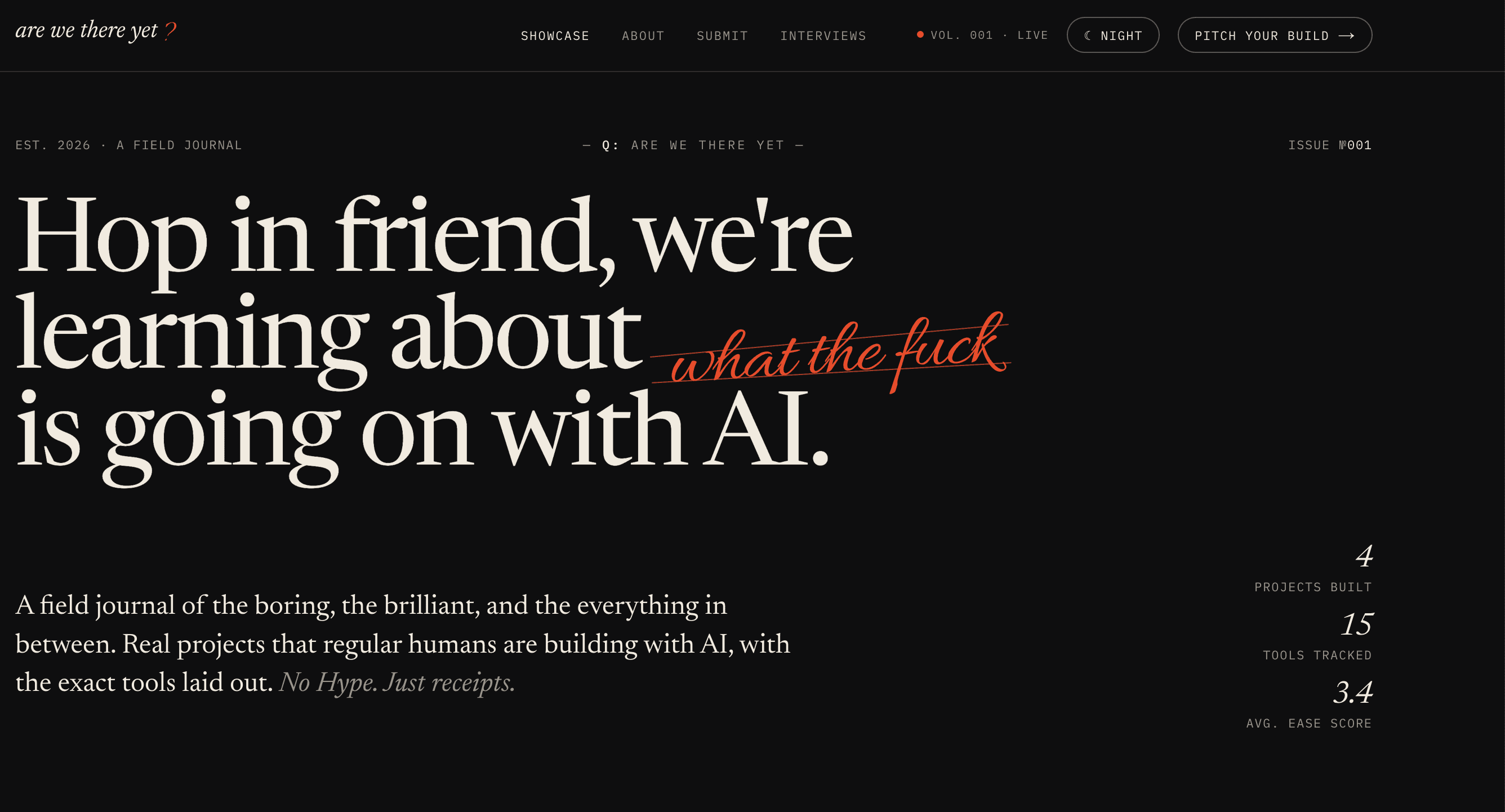
§ 01 · What we builtA literary magazine for AI builders, shipped in a weekend.
are we there yet? is a field journal of normal people building real things with AI — scored by how hard they'd be to copy, with the exact tools laid out. We designed it, built it, and pushed it live in forty-two hours flat.
The artifact is a static site: a homepage with a curated showcase, post pages like the one you're reading, an about page, and a submission form. No CMS, no database, no auth. Editing a post means editing an MDX file. We wanted it to feel like a magazine, not a SaaS.
§ 02 · Problem being solvedEvery AI essay is about prophets. Nobody writes about the people.
We kept reading "AI is going to" pieces and getting the same hollow feeling. Going to do what? Going to do it when? Meanwhile the most interesting people we knew were quietly shipping weird, useful, slightly-cursed projects on a Tuesday afternoon — and nobody was writing about them.
The gap we set out to fill: a publication that takes the amateur seriously. A parents-by-text dad. A PM who automated her own job. A guy posting daily to LinkedIn without ever opening LinkedIn. We wanted to publish the receipts — the actual tools, the actual ease score, the thing that broke at 2am — not the LinkedIn-poisoned post-mortem.
§ 03 · What was the hardest partThe first four hours, when there wasn't any code.
The hardest part was not the building. It was deciding, with conviction, what we were refusing to build. AI tools are very happy to give you the average of everything. Most weekend sites end up looking like the average of everything. Ours couldn't.
Before any code, we made a single FigJam frame with three columns: what this magazine is, what it isn't, what it sounds like. Filling that out took 90 minutes and saved us roughly the entire weekend.
§ 04 · What went wrongThe cursive font took down the layout for three hours.
We were loading Allura via @import inside the stylesheet. On the first deploy, Vercel served the CSS from a CDN edge that hadn't fetched the font yet, and every cursive accent rendered as Times — which broke the kerning, which pushed the headline to two lines, which made the whole front page look like a 2008 WordPress blog.
§ 05 · What you learnedThree lessons, in descending order of smugness.
One: the brief is 80% of the work. We thought we were "vibe-coding" — what we were actually doing was writing very long, very specific English sentences about what we wanted, and watching Claude type them into HTML.
Two: opinions over options. Every time Claude offered us three directions we got worse output than when we said "do this, in this exact way." Generative tools amplify whoever is loudest in the room. We made sure that was us.
Three: the weird stuff is what makes it a magazine. Anyone can ship a black-and-white serif site in a weekend. The cursive annotations, the margin scribbles, the red question mark — those took about six hours total. They are why the site has a feeling.